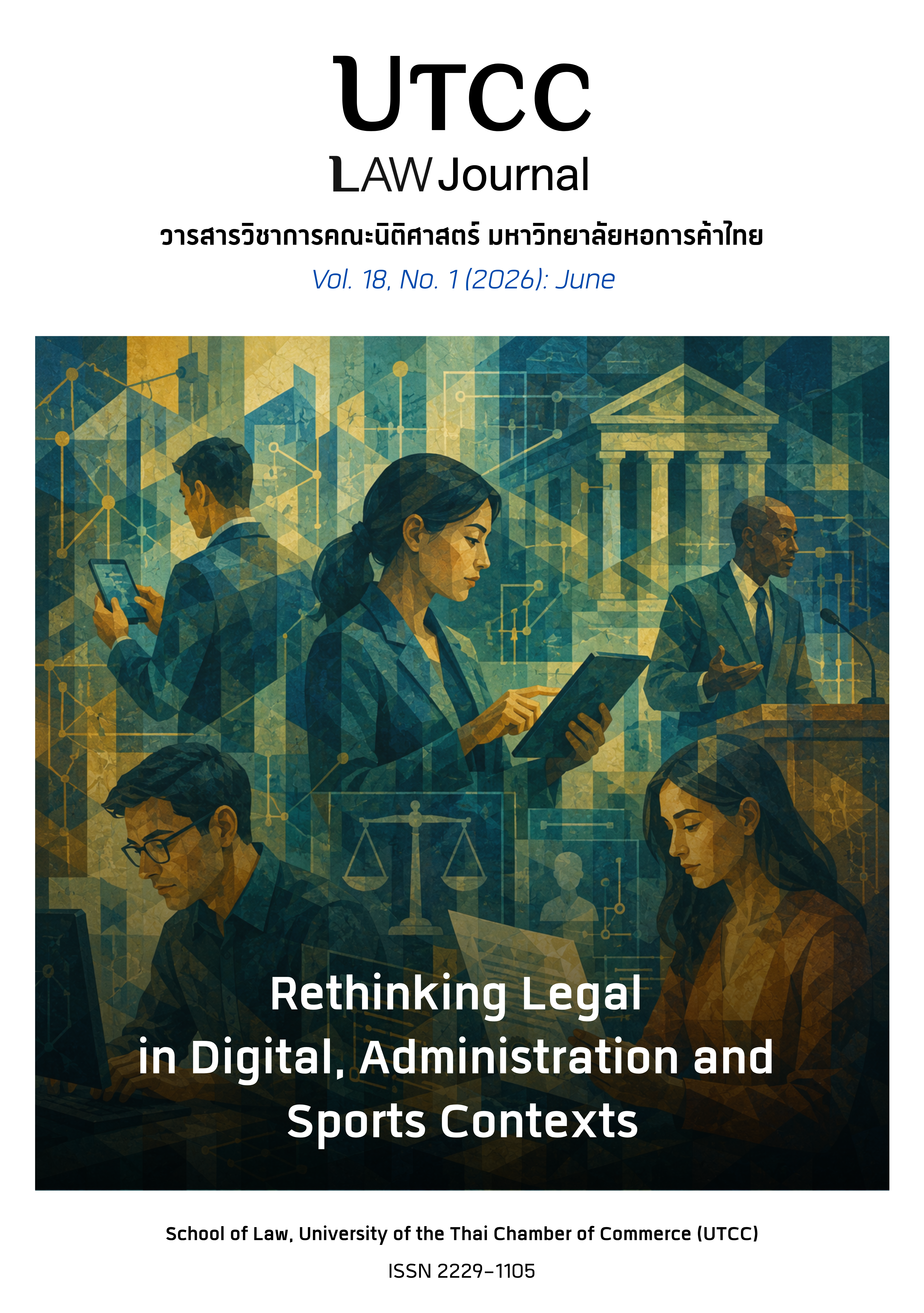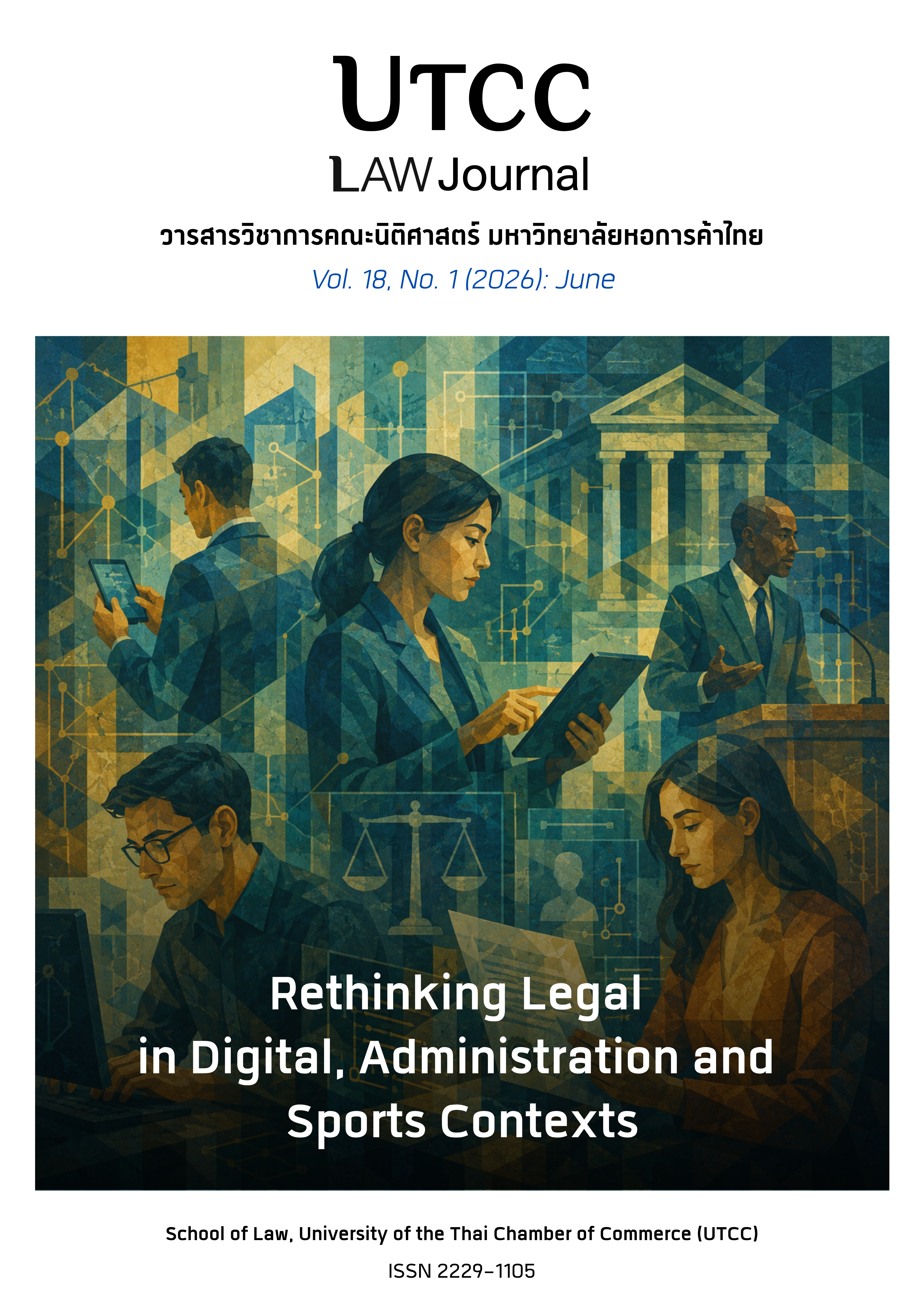
Vol. 18 No. 1 (2026): UTCC Law Journal
UTCC Law Journal
Chiedf Editor: Assist.prof. Veena Anusornsena, Ph.D.
The UTCC Law Journal, Vol. 18 No. 1, June 2026, presents a collection of articles that reflects significant transformations in contemporary law amid rapidly changing economic, social, technological, and international contexts. Legal issues once examined within conventional frameworks—whether concerning contracts, commercial documents, arbitration, economic regulation, public health protection, or international trade—are now being challenged by the growing complexity of the modern world.
The articles in this issue demonstrate that law does not merely define rights, duties, or liabilities. It also serves as an essential infrastructure for building trust, allocating risks, and governing activities that are increasingly transnational and technology-dependent. The article on electronic bills of lading highlights the importance of connecting model laws, technical standards, and industry mechanisms to support the development of international digital trade. Meanwhile, the articles on automated contracts, both in the context of the European Union and Thai sale law, invite readers to reconsider the foundations of contract law, particularly in relation to intention, mistake, and risk allocation when contractual decisions are made through automated systems.
This issue also explores specialized legal fields with important implications for economic and social development. The article on the principle of Kompetenz-Kompetenz in the Court of Arbitration for Sport illustrates the role of specialized international dispute resolution institutions. The article on Thailand’s low Earth orbit satellite business ecosystem points to the need for a clearer and more integrated legal framework to support modern space activities, investment, innovation, and liability in high-risk activities.
In another dimension, the article on the Alcoholic Beverage Control Act, B.E. 2568 (2025), and its related secondary legislation reflects the challenges of legal enforcement in balancing public health objectives, fairness to business operators, and clarity in the exercise of state authority. At the same time, the article on the European Union Packaging and Packaging Waste Regulation, or PPWR, shows that foreign environmental regulation can directly affect Thai businesses participating in global supply chains. Compliance with sustainability standards has therefore become an important condition for maintaining competitiveness.
Finally, the book review of International Law: A Very Short Introduction enriches this issue by encouraging readers to revisit the significance of international law at a time when the global order and relations among states are marked by uncertainty. Understanding international law is therefore not merely a matter for specialists, but a form of foundational knowledge that helps us situate Thai law within an increasingly interconnected world.
The editorial board hopes that this issue will serve as an academic platform for critical inquiry, intellectual exchange, and the advancement of legal scholarship in response to contemporary changes. We hope it will contribute to theoretical reflection, legal interpretation, policy design, and the practical application of law.
The editorial board would like to express its sincere appreciation to all contributors, peer reviewers, and everyone involved in bringing this issue to completion. We sincerely hope that this issue will be useful to lecturers, scholars, students, legal professionals, policymakers, and all readers interested in the development of law in contemporary society.
Published:
2026-06-29