Peer Review Process
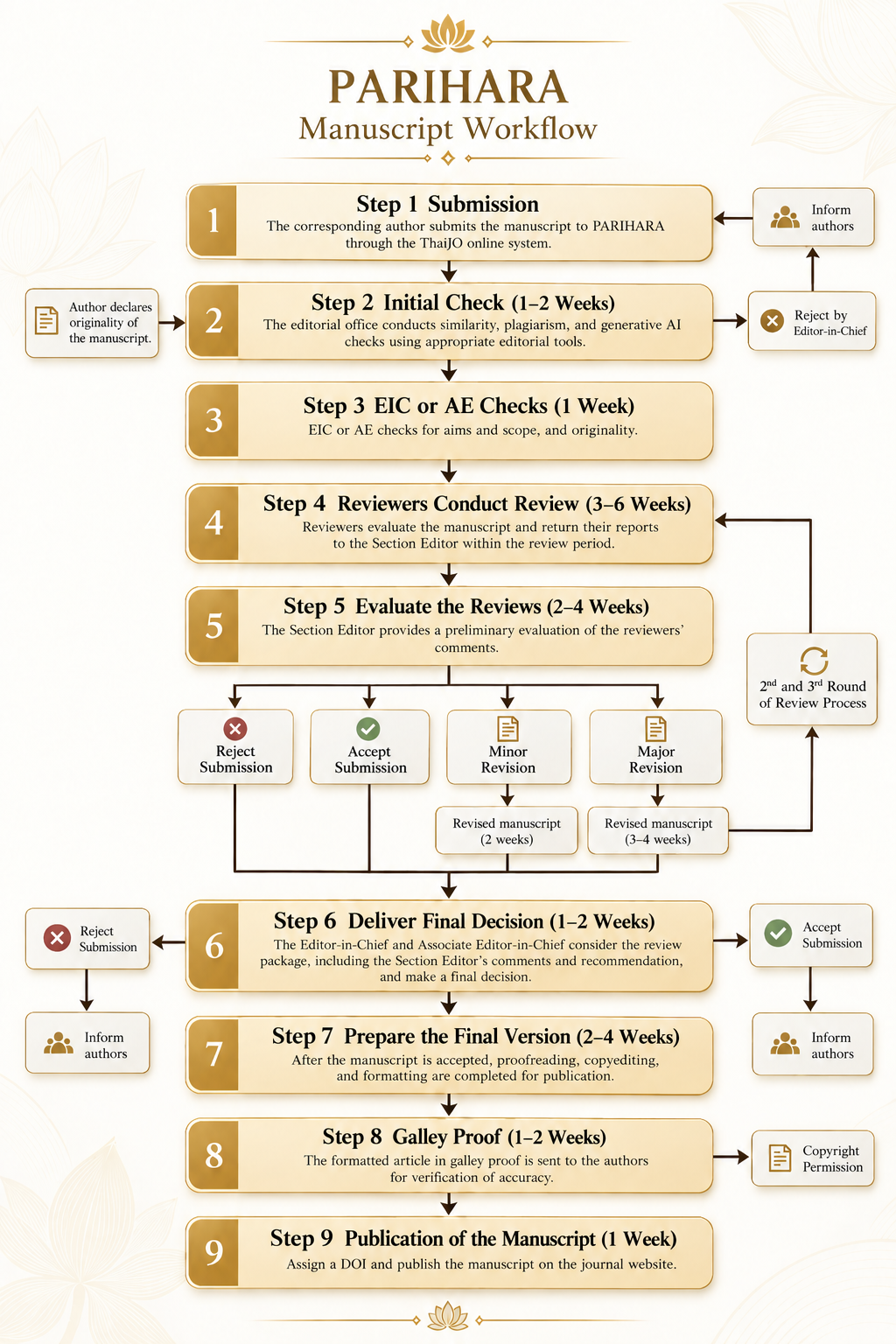 PARIHARA Manuscript Workflow
The manuscript workflow of PARIHARA: Buddhist Community Management is designed to ensure that every submission is handled through a transparent, rigorous, and academically independent process. The workflow covers the entire publication cycle, from initial submission through editorial screening, peer review, revision, final decision, production, and publication. The process is conducted through the ThaiJO online journal system and follows the journal’s policies on research integrity, double-anonymized peer review, editorial independence, and publication ethics.
-
Step 1: Submission
The corresponding author submits the manuscript through the PARIHARA online submission system on ThaiJO. At this stage, the author is responsible for ensuring that the manuscript complies with the journal’s Author Guidelines, formatting requirements, reference style, ethical policies, and submission checklist. The corresponding author must also confirm that the manuscript is original, has not been previously published, and is not simultaneously under consideration by another journal. Required declarations concerning authorship, conflicts of interest, research ethics, funding, data availability, and the use of generative AI or AI-assisted technologies should also be provided where applicable.Estimated time: Submission is recorded immediately upon successful completion of the online submission process.
-
Step 2: Initial Check — 1–2 Weeks
After submission, the editorial office conducts an initial technical and research-integrity screening. This stage is intended to determine whether the manuscript is sufficiently complete and suitable to proceed to academic editorial assessment.The editorial office checks the manuscript for compliance with submission requirements, completeness of metadata and author information, similarity with previously published material, possible plagiarism or inappropriate text reuse, and issues relating to the use of generative AI or AI-assisted technologies. Appropriate editorial and similarity-checking tools may be used to support this process.
The initial check does not determine the final scholarly merit of the manuscript. Rather, it is intended to identify technical, ethical, or integrity-related concerns before the manuscript proceeds further.
If serious problems are identified, the manuscript may be referred to the Editor-in-Chief for rejection. Authors will be informed of the decision where the manuscript does not meet the minimum submission or integrity requirements.
-
Step 3: EIC or AE Checks for Aims, Scope, and Originality — 1 Week
Manuscripts that successfully pass the initial check are evaluated by the Editor-in-Chief (EIC) or an assigned Associate Editor (AE).At this stage, the editor assesses whether the manuscript fits the journal’s Aims and Scope, demonstrates sufficient scholarly originality, and has the potential to make a meaningful contribution to Buddhist Community Management.
Particular attention is given to whether the manuscript meaningfully connects the journal’s three core domains:
Buddhism; Management and Governance; and Community and Social Development.
The editor also considers whether the research problem, research gap, conceptual basis, methodology, and potential contribution are sufficiently clear to justify external peer review.
A manuscript may be rejected at this stage without external review if it is clearly outside the journal’s scope, lacks sufficient originality, does not meet minimum academic standards, or does not demonstrate a meaningful relationship with the journal’s scholarly identity.
-
Step 4: Reviewers Conduct Review — 3–6 Weeks
Manuscripts that pass the editorial assessment are sent for external peer review. PARIHARA applies a double-anonymized peer review process, meaning that the identities of authors and reviewers are concealed from one another during the review process.Qualified reviewers with expertise relevant to the manuscript are invited to assess the work. Reviewers evaluate matters such as originality, academic significance, theoretical or conceptual foundation, methodological rigor, quality of evidence, interpretation of results, engagement with relevant literature, ethical considerations, clarity of presentation, and contribution to Buddhist Community Management.
Reviewers are expected to provide constructive, evidence-based, and academically justified comments. Their recommendations may include acceptance, minor revision, major revision, or rejection.
Reviewers submit their reports to the responsible editor through the journal system within the agreed review period.
-
Step 5: Evaluation of the Reviews — 2–4 Weeks
After the peer-review reports have been received, the responsible editor evaluates the reviewers’ comments and recommendations.The editor does not simply count reviewer recommendations. Instead, the reviews are assessed in terms of their academic reasoning, consistency, relevance, and the seriousness of the issues raised.
Four principal outcomes may follow. A manuscript may be rejected if substantial academic, methodological, ethical, or conceptual weaknesses cannot reasonably be corrected. It may be accepted when the reviewers and editor consider the manuscript ready for publication or requiring only negligible changes. A minor revision may be requested where improvements are necessary but do not substantially affect the study’s central argument or methodology. A major revision may be requested where significant changes are required to the theoretical framework, methodology, analysis, interpretation, organization, or contribution.
Authors receiving a revision decision must normally submit both a revised manuscript and a point-by-point response explaining how each reviewer and editor comment has been addressed.
For minor revisions, authors are generally expected to submit the revised manuscript within approximately 2 weeks.
For major revisions, authors are generally expected to submit the revised manuscript within approximately 3–4 weeks.
Depending on the extent of the revisions, the revised manuscript may be returned to the original reviewers for a second or third round of peer review. The review–revision cycle may continue until the editor determines that the manuscript is ready for a final editorial decision or that further revision is unlikely to resolve the remaining concerns.
-
Step 6: Final Editorial Decision — 1–2 Weeks
Once the peer-review and revision process has been completed, the full review package is considered for a final decision.The Editor-in-Chief and the responsible Associate Editor review the manuscript, reviewer reports, author responses, revised versions, and the recommendations made during the editorial process.
The final decision is based on the overall academic quality of the manuscript, adequacy of revisions, methodological and ethical integrity, originality, relevance to the journal’s Aims and Scope, and contribution to the field.
The final decision may be either Accept Submission or Reject Submission.
Authors are formally informed of the final editorial decision through the journal system.
Reviewer recommendations remain advisory. The final responsibility for publication decisions rests with the journal’s editorial leadership, provided that the responsible editor has no conflict of interest relating to the manuscript.
-
Step 7: Preparation of the Final Version — 2–4 Weeks
Once a manuscript has been formally accepted, it enters the production stage.The manuscript undergoes editorial preparation, which may include proofreading, copyediting, reference checking, language editing where necessary, verification of author information and affiliations, checking of tables and figures, formatting according to the PARIHARA article template, and verification of required declarations.
The editorial office also checks that metadata recorded in ThaiJO corresponds accurately with the final article, including the article title, author names, affiliations, abstract, keywords, and references.
Authors may be contacted during this stage if clarification or minor corrections are required. However, substantial changes to the academic content are not normally permitted after formal acceptance unless required to correct a serious error.
-
Step 8: Galley Proof — 1–2 Weeks
After copyediting and formatting are completed, the manuscript is converted into its final publication layout or galley proof.The corresponding author receives the galley proof for final verification. Authors should carefully check the accuracy of author names, affiliations, title, abstract, tables, figures, references, pagination, and other publication details.
At the proof stage, corrections should generally be limited to typographical, formatting, factual, or production errors. Major rewriting, substantial additions, removal of results, or changes to authorship are not normally permitted without editorial approval.
Any copyright or permission issues relating to third-party figures, tables, images, or other copyrighted materials must also be resolved before publication.
Authors are expected to return the corrected proof within the timeframe specified by the editorial office.
-
Step 9: Publication of the Manuscript — Approximately 1 Week
After the galley proof has been approved and all publication requirements have been completed, the article is prepared for online publication.Where applicable, a Digital Object Identifier (DOI) is assigned and the final Version of Record is published on the PARIHARA journal website through the ThaiJO platform.
The published article should display complete bibliographic and editorial information, including the article title, author names and affiliations, abstract, keywords, publication date, and relevant editorial-history dates such as Received, Revised, Accepted, and Published.
The article is made immediately available under the journal’s open access policy and applicable Creative Commons license.
Review and Revision Cycle
An important feature of the PARIHARA workflow is that peer review is not necessarily a single-round process. Manuscripts requiring substantial revision may undergo a second or third review round. The purpose of additional rounds is not to delay publication but to ensure that important scholarly concerns have been adequately addressed and that the final article meets the journal’s standards for academic rigor, research integrity, and contribution to Buddhist Community Management.
Overall Processing Time
The total publication timeline varies depending on reviewer availability, the complexity of reviewer comments, the quality of author revisions, and the number of review rounds required. Authors should therefore regard the timeframes shown in the workflow as indicative rather than guaranteed. Manuscripts requiring substantial revision or additional peer review may take longer.
Throughout the process, PARIHARA seeks to balance rigorous academic evaluation with timely, transparent, and fair editorial management. The central purpose of the workflow is not simply to move manuscripts toward publication, but to ensure that published articles meet the journal’s standards of originality, methodological rigor, ethical integrity, and meaningful integration of Buddhism, management and governance, and community and social development.